
Finding Pharr Residents by Record Type
No official source is a complete list of Pharr residents. A record is useful when it answers a narrow question. An address can lead to the Hidalgo County tax search, an owner name to an appraisal record, and a recorded party to the County Clerk index. A dated family-history question may be better served by Pharr Memorial Library, the Pharr Press collection, or a state archive. For a city citation, the municipal court has its own search. Start with the person, place, or date already known, then keep the record’s jurisdiction beside the result.
A name hit is a lead, not proof. Compare the spelling, the record date, the address or legal description, and a second independent source. A tax roll can show a parcel relationship, while a newspaper item can show a past connection. Neither alone proves that someone is currently at an address. When formal proof is needed, ask the custodian for the appropriate copy instead of relying on a search screen.
- For an address, use the Hidalgo County tax search and retain the account or CAD reference.
- Check a recorded ownership trail through the Hidalgo County official-records index.
- For a historical name, search the Pharr Memorial Library collection with spelling and language variants.
- Use the official voter-status route only for registration status, and respect confidential or protected addresses.
- When a disclosed file is not online, request the existing record from the city or county custodian.
Pharr Resident Records Offices
Pharr municipal files and Hidalgo County files are not interchangeable. The City Clerk routes city public-information requests and handles eligible local vital-record questions. Hidalgo County holds recorded instruments, tax records, appraisal information, county courts, and election administration. The City of Pharr remains the likely custodian for city permits, code matters, fire reports, and municipal elections. A full address trail belongs on the Pharr by-street directory; the cards below identify the first office to contact.
Hidalgo County Appraisal District
4405 S Professional Dr
Edinburg, TX 78540
956-381-8466
Hidalgo County Elections
County voter registrar
Hidalgo County, TX
956-318-2570
Pharr Address Record Search
The Hidalgo tax portal is a practical starting point when a Pharr street address is known. It has a first search criterion for Owner Name, Property Address, Account No., CAD Reference No., or Fiduciary No., then an optional second criterion. The address option is a “Starts With” search, so use the complete street number and a plain street form, then preserve the resulting account or CAD reference. The portal warns that its information may not be accurate or reliable, so compare it with the County Clerk record or official HCAD route.
| Tax search field | How it works | Useful handoff |
|---|---|---|
| Owner Name | Last name first | Compare with an address or account |
| Property Address | Starts With format | Account and CAD reference |
| Account No. | Exact account identifier | Tax and appraisal record |
| CAD Reference No. | Exact CAD key | Parcel and legal-description checks |
See the official Hidalgo tax search before trying a name-only search. The captured interface shows its two-stage criteria choices.
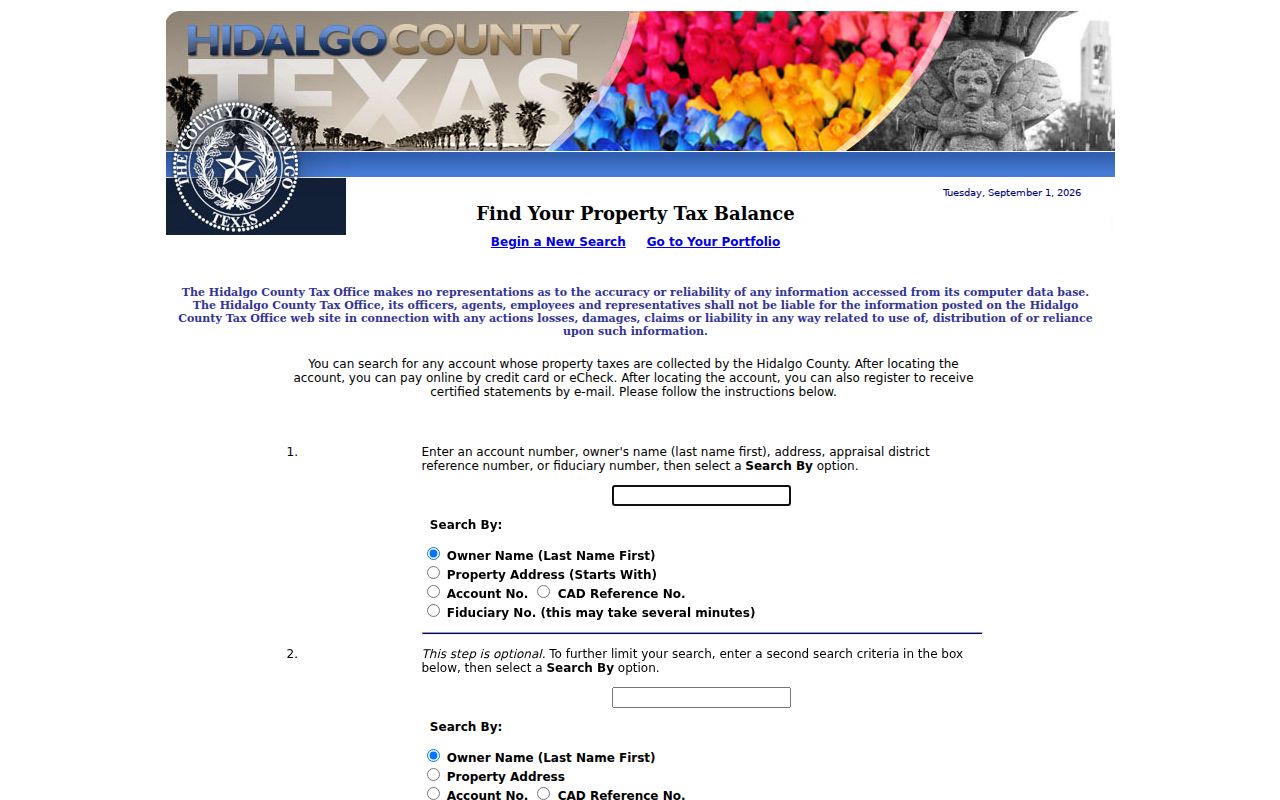
The form’s address and reference fields make it possible to carry a parcel key into the next record without assuming the mailing address and location address are identical.
Pharr Clerk Records Search
The Hidalgo County Clerk’s official records portal is a document index, not a current-resident list. Its Quick Search and Advanced Search accept a search term for a grantor or grantee, subdivision, document type, or document number. A recorded-date range can narrow the results. “Search Index Only” treats multiple words separately; “Search Index & Full Text” uses OCR phrase searching. The help material also describes party roles, document groups, AND, OR, NOT, and image-text tools, although image text is not available for every document.
A grantor is the party transferring an interest. A grantee is the party receiving it. Open the image and compare the legal description, instrument number, and recording date before drawing conclusions from an index result. The portal did not display an online start year during research, so older work may require the clerk or the state microfilm inventory.
The official records portal exposes the quick and advanced controls shown here.
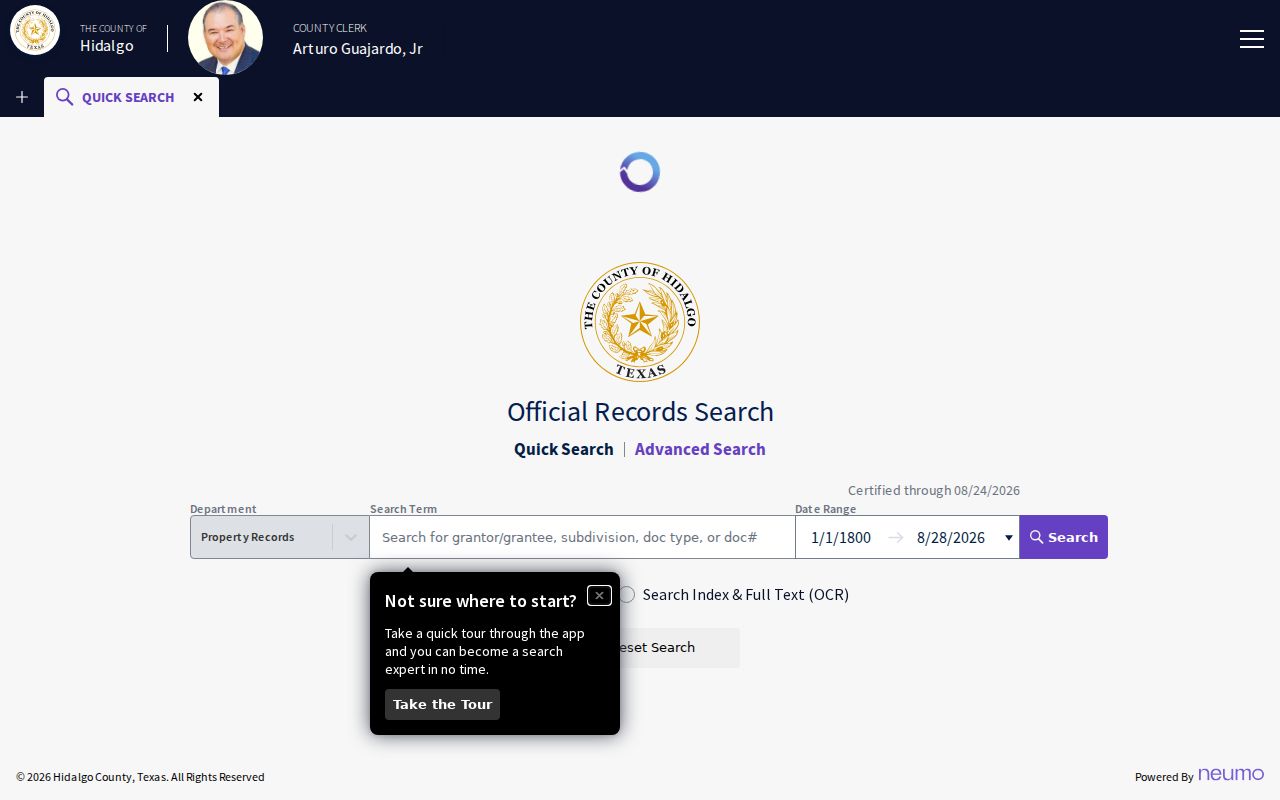
This screen is a useful index lead. A certified copy, when required, comes from the County Clerk rather than from an informal portal result.
Pharr Records Request Routes
Some municipal files have no public search box. The Pharr public-information request route requires a written request and offers an online portal, email, fax, mail, and in-person delivery. The city form asks whether copies or inspection are preferred and calls for a detailed description. Give the existing record type, department, date range, address or case reference, and preferred format. A request does not require the city to create a document, answer a question, or keep a standing request open.
The City of Pharr government hub is the source shown in this image and links to department services.
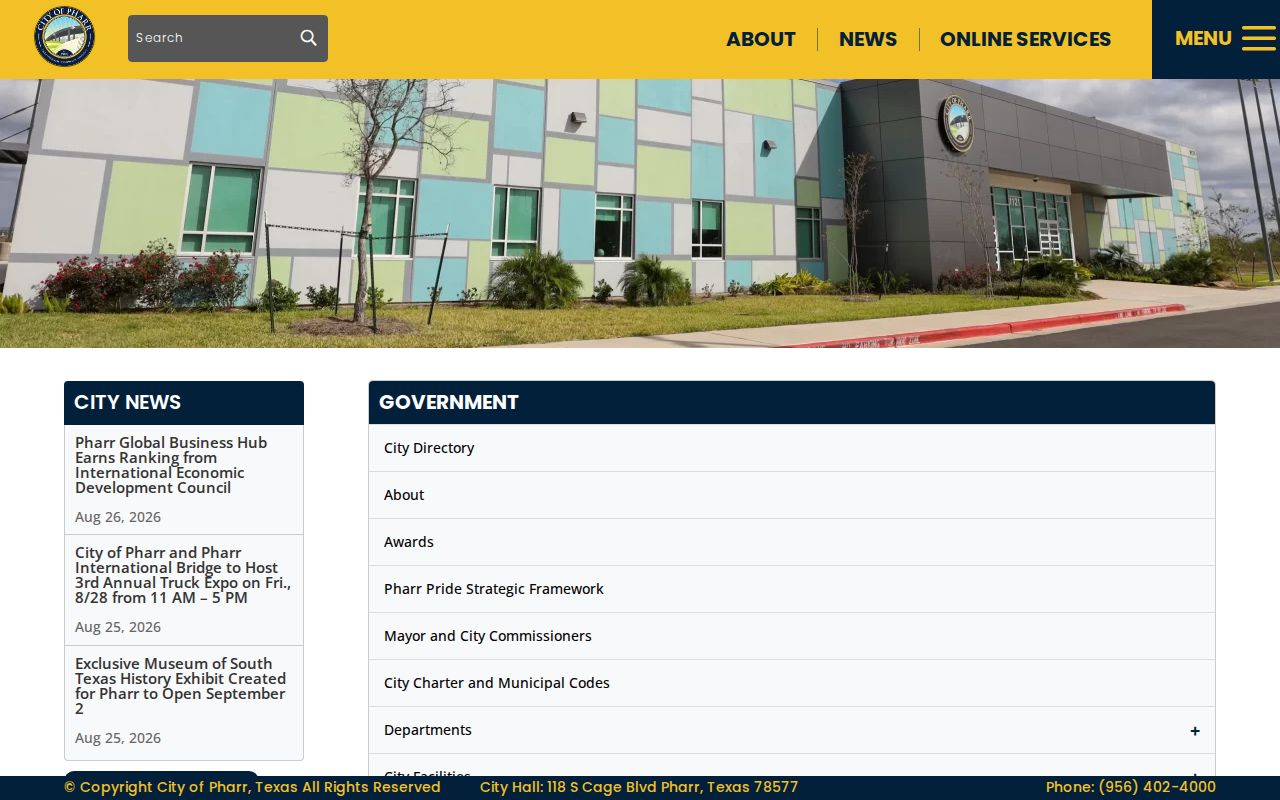
Use the department landing page to distinguish a city-held permit, code file, election notice, or fire record from a county-held parcel or deed record.
The captured Pharr request page shows the written-request channels.
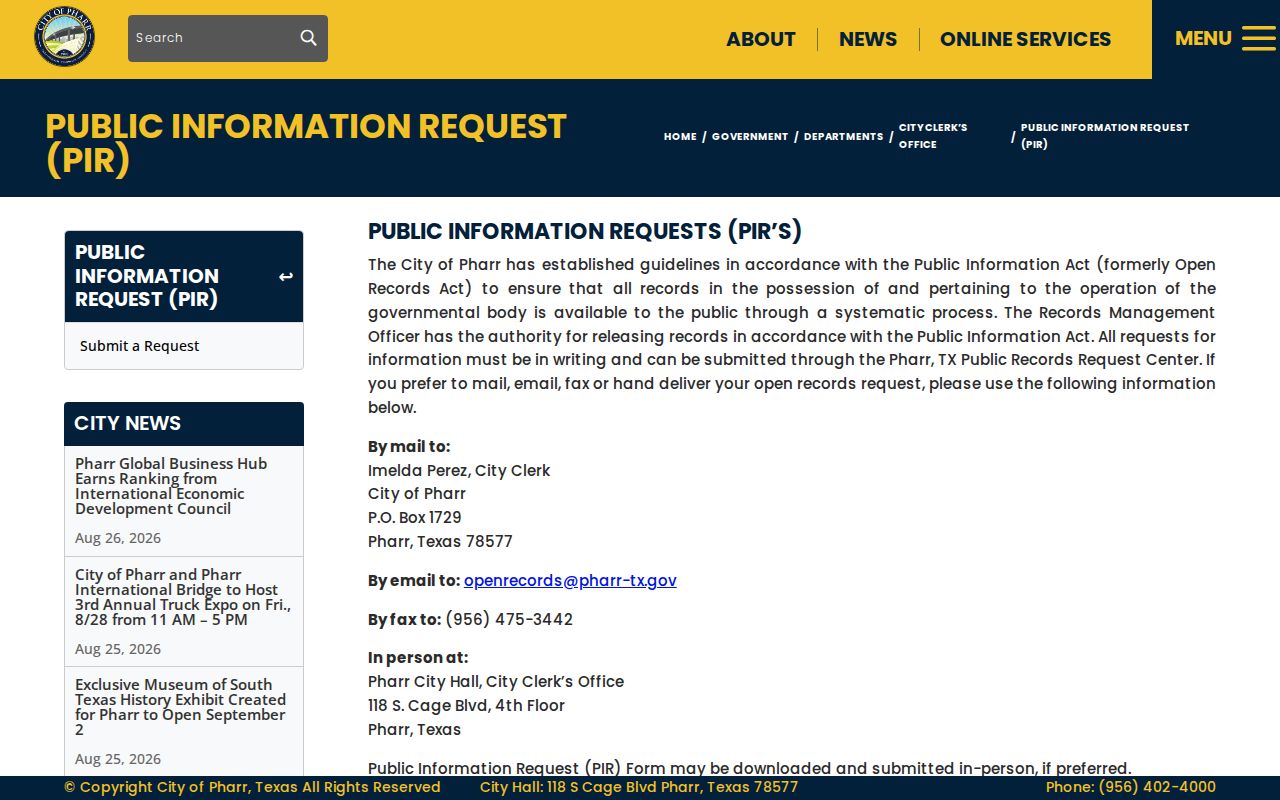
If the likely custodian is county rather than city, use the Hidalgo County written-request route instead and identify the subject, location, and dates.
Pharr Resident Directory Sources Today
Current directory-like sources each have a limited scope. The tax and appraisal systems connect owners and parcels. The deed index identifies parties to recorded instruments. Voter tools address registration and election status under Texas rules, not a general address directory. The library, local archives, and public records requests fill different gaps. Keeping the custodian and the access date with each result makes the Pharr residents directory more useful and less likely to confuse an older association with a current one.
| Pharr source | What it can show | Custodian | Access route |
|---|---|---|---|
| Tax and appraisal record | Parcel, location, owner, value fields | Hidalgo County / HCAD | Official tax and HCAD routes |
| Official records index | Deed, plat, lien, or release parties | Hidalgo County Clerk | Online index, clerk copy |
| Voter status tools | Registration or ballot context | SOS / Hidalgo Elections | Official status or ballot route |
| Pharr Press and yearbooks | Dated historical connections | Pharr Memorial Library | Digital and archive access |
| City or county file | Existing administrative record | Relevant custodian | Written request or inspection |
For one person, use the Pharr resident lookup workflow to compare sources rather than treating a single listing as conclusive. A parcel is a defined tract of land; it is not a roster of everyone connected to that address.
Pharr Voter Record Limits
Texas provides an official “Am I Registered?” route that accepts a VUID, a Texas driver license number when it was supplied in registration, or a first and last name. Hidalgo’s sample-ballot lookup asks for first name, last name, and date-of-birth selectors. A suspense status can mean that the registrar needs address confirmation. It does not establish that a person has left an address. Registration becomes effective after an accepted application and the state describes a 30-day deadline before an election.
Name, date of birth, and voter ID have a different public status from confidential identity fields. How someone voted is not public. A qualifying address can be protected through Texas confidentiality programs, and a protected entry may use an asterisk or not appear in an ordinary county file.
Use a narrow purpose. Keep protected addresses and identity numbers out of personal notes, and never use public sources to work around an address-confidentiality program.
Note: Voter status is election information, not a certificate of current Pharr residence.
Pharr Press Record Searches
Pharr Memorial Library’s partner collection at Portal to Texas History offers a local way to document a name in a particular period. The partner page reports 764 items across four collections, mostly Pharr Press and related newspaper material. Its visible decade filters run from the 1950s through the 1980s, and it supports Guided, Advanced, and Proximity Search. Search across Full Text, Metadata, Title, Subjects, Creators, and Names, then save the item title, date, page or image, collection, and stable URL.
Newspaper OCR can miss a column, accent, or misspelling. Search the full name, surname, street, school, organization, and event date. An article can support a dated relationship or civic connection. It cannot by itself establish present residence or merge two people with the same name.
- Index
- A searchable pointer to a record, often requiring the original image or custodian copy for confirmation.
- Parcel
- A defined piece of land identified by an account, map, or legal description.
- Criss-cross directory
- An address-arranged directory, useful when a verified historical volume is available.
- Record date
- The date a source was made or recorded, which may differ from the date it was digitized.
Pharr Records in Spanish
The Pharr Memorial Library collection reports 312 Spanish-language items. That number matters when a surname, organization, or location has Spanish and English forms. Search each reasonable form, first as printed and then without accents if OCR returns too little. Inspect the scanned page instead of relying only on a transcription. Older Hidalgo County work can also involve Spanish-transcribed deed material in the Texas State Library and Archives Commission inventory.
Pharr’s cross-border setting makes jurisdiction especially important. A similar name in a Pharr newspaper, a Hidalgo deed, or a record from outside Texas is not automatically the same person. Keep the government level and source date with the result.
Historical Pharr Resident Directories
Research did not locate an official Pharr city-directory publisher, year run, page image, or sample entry. Do not assume that a named printed directory exists for a particular year. The sound fallback is Pharr Memorial Library Local Archives, the TSLAC city-directory guide, UNT and Briscoe Center holdings, UTRGV’s Edinburg depository, and verified newspaper or yearbook material. The fuller collection method is on the Pharr city directories page.
TSLAC describes city directories as sources that commonly contain a name, address, telephone, spouse, descriptors, and an occupancy indicator. The state library’s print and microform directories are mainly on-site in Austin, and staff do not search or transcribe them by phone or email. Pair a verified directory year with a census period, deed, tax card, or newspaper item so the dated household trail has more than one source.
Pharr Fire Records Trail
Pharr Fire history records a July 1916 square-block fire that destroyed Pharr Lumber, Pharr Mercantile, Folsom Hardware, National Theatre, and other businesses. The first equipment arrived in early 1917, volunteer firefighting began that year, and an organized department followed in 1922. This is a useful local research anchor: search the fire date and business names in Pharr Press, then ask for existing city council, fire, rebuilding, or recorded-property material by date and affected block.
The fire is a historical search project, not a shortcut to a person match. Confirm each association with the item date and an underlying property or archive record.
Pharr Civic Record Geography
Pharr’s Community Development Council has 11 residents representing seven census tracts. Tract information can give context to a city meeting, a CDBG plan, a map, or a historical address. It is not a household directory. Use the council’s public materials and official map layers for civic context, then avoid inferring that a person belongs to a tract solely because an address is nearby.
The Census QuickFacts profile for Pharr is the source represented below.
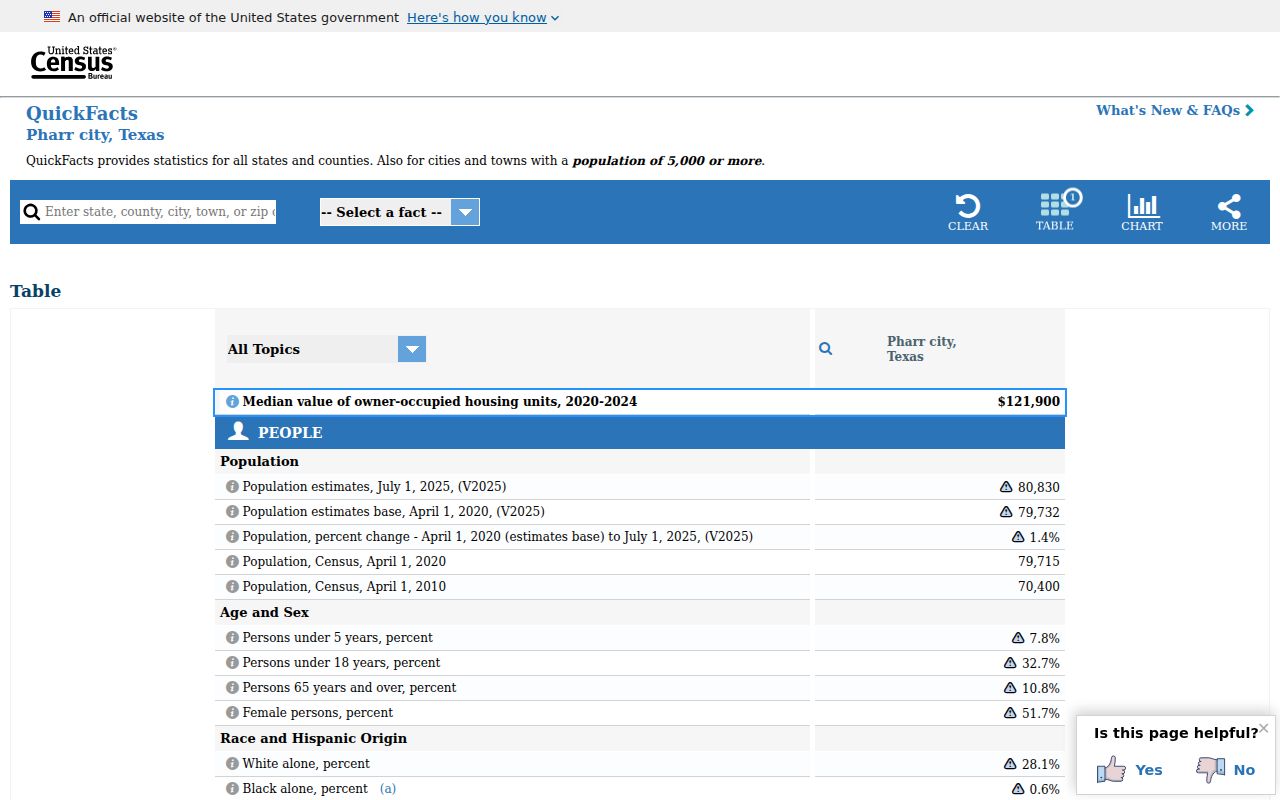
Citywide statistics explain community context, but they are never a named-person search result.
Pharr State Records by Purpose
Use a Texas-wide source only when the question is statewide. DSHS and OVRA handle eligible vital-record orders. DPS offers a name-based criminal-history route that is not fingerprint confirmation. TDCJ and the federal BOP run separate custody systems. The Secretary of State administers voter information and statewide voter-file requests with formal controls. Professional and business records belong to the specific Texas custodian, such as the Secretary of State, TDLR, or a licensing board.
The TDLR License ID Search has Establishment, Individual, and School tabs, plus license-type and name or number controls.
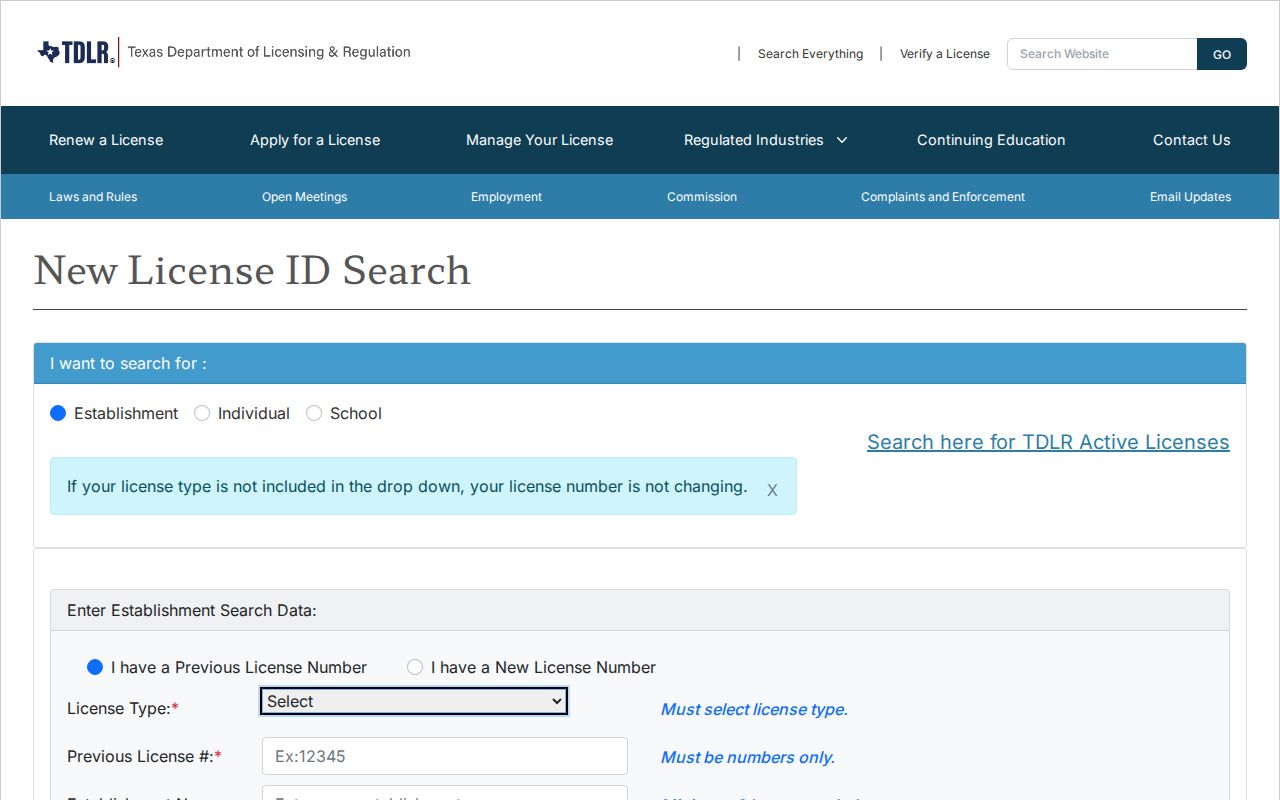
A state result should be recorded with the agency, source date, and its stated limits before it is compared with a Pharr or Hidalgo County record.
Pharr Records Portal Fallbacks
An official screen can be incomplete, changed, or unavailable. The court portal did not expose a complete current field inventory during research. HCAD’s public landing page was available, but current interactive search fields were not exposed in official text. Pharr Building Safety identifies an Accela-based permit, application, registration, and inspection route without publishing a direct public URL. Preserve the official landing-page URL and the access date, then move to the custodian’s phone, counter, or written-request path.
The County Clerk portal displayed a certification date of August 24, 2026, but did not publish an index start year. A missing online result can reflect a spelling variation, an unscanned image, an older record, or a different custodian. For historical Hidalgo material, the Texas State Library and Archives Commission inventory identifies deed, marriage, probate, court-minute, and map reels that can be used through the UTRGV Edinburg depository or state-library routes.
Texas Government Code Chapter 552, the Texas Public Information Act, concerns existing governmental information. A focused request identifies the existing record, custodian, date range, place, and desired copy or inspection method. The city and county may clarify a request, estimate charges, or withhold information under applicable rules. Note: The best fallback is usually the office that created the record, not a substitute portal.